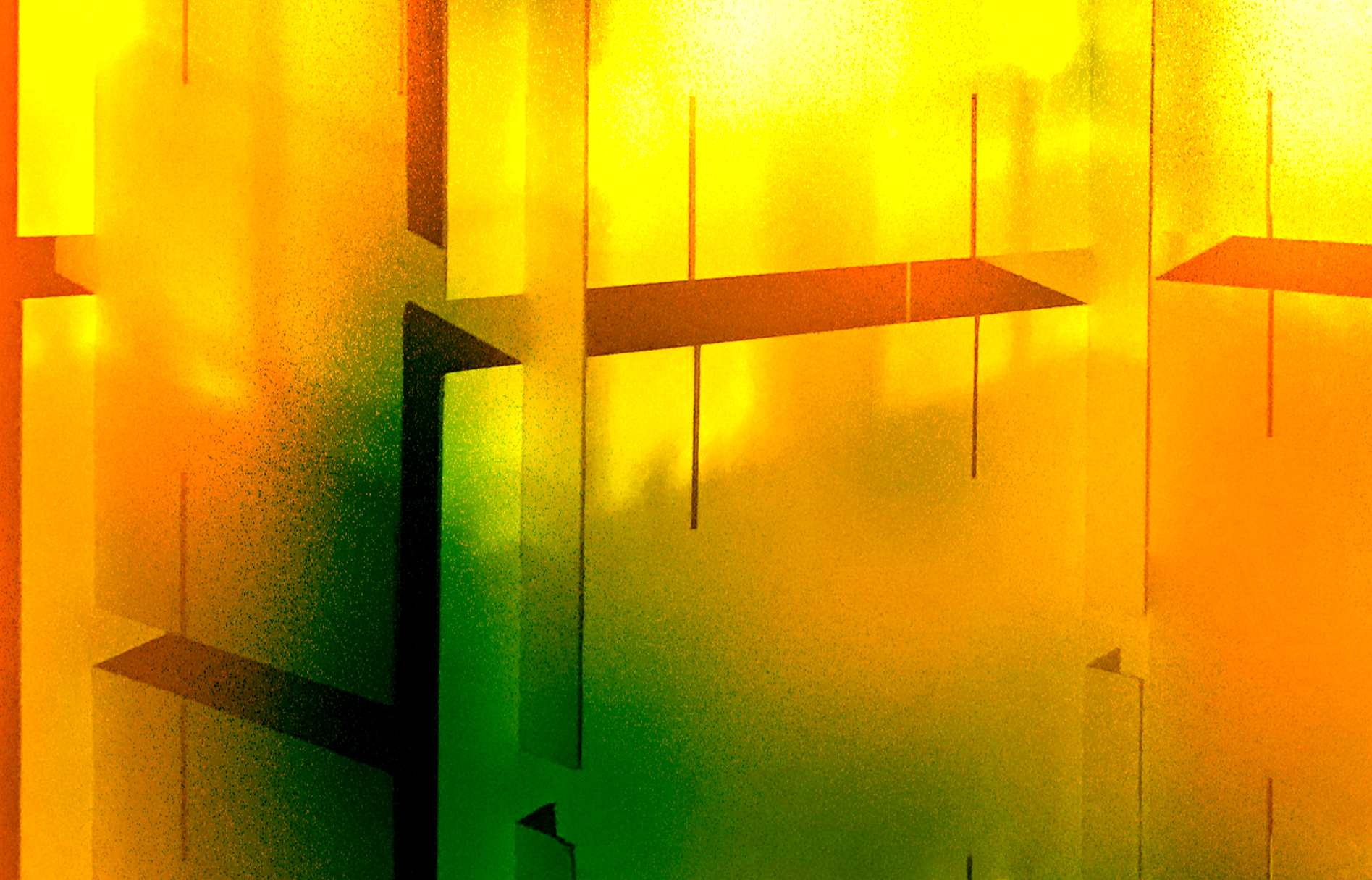
The excerpts above were from a showing of Part 1 we did at PAGEANT (Thanks to Owen Prum) in Brooklyn with choreographer Jude Markey-Smith. The entire work, described below, will be performed in NYC in late spring ’26 and in Europe during summer ’26. Specific dates/venues will be on our about page in early spring ’26. Below is our working premise.
About Thresholds
A performance for dancer, sculptural field, live sound, and projection
The stage begins as a measured geometry: a rectangle inscribed according to the Golden Mean, its diagonals and reciprocals are calculated and fragments of them are drawn in tape across the floor. Before the audience arrives, the performers calculate and mark this field, its proportions echoing an underlying harmonic order. At intersections of these lines, sculptural objects are placed — modular forms of raw balsa wood, assembled into varying heights and angles. Their dimensions determine the gravity of their presence: each emits a subtle field, attracting or repelling movement, exerting force through proportion rather than power.
The piece is in the form of an arc: Part 1 is cosmological order ? Part 2 is psychological enclosure ? Part 3 is phenomenological participation.
Conceptual Frame
About Thresholds stages a passage through three orders of experience:
1. Cosmological – the harmony of proportion and the body in relation to the world.
2. Psychological – the turn inward, where image and sound echo within consciousness.
3. Phenomenological – the rejoining of the two, where self and world balance through shared presence.
What begins as a measured dance becomes a meditation on the nature of balance itself — between interior and exterior, thought and body, pulse and proportion. The work proposes that “inner experience,” rather than being a private depth, may be a displaced form of cosmic relation. In the final gesture, as dancer and audience share the same twilight, not as belief, but as lived alignment.
First Movement – The Pulse of Geometry
A single dancer enters the illuminated stage. The lighting is full and even, as if in a brightly lit room; the audience remains in darkness, witnesses to an ordered field. Before moving, he takes his pulse, reading the tempo of his own body — the private metronome of the modern being. He notes the number — a simple, empirical act, yet one that carries the modern condition: the self as self-measurer. His heartbeat establishes the initial tempo of the music and the movement.
His dance begins in this inner rhythm, but as he crosses the measured space, the geometry begins to act upon him. The sculptural nodes tug at his movement; his tempo shifts as he nears or leaves them. The body that began as self-contained is gradually drawn into relation. Midway through, he pauses, takes his pulse again, and begins to reposition the sculptural elements. The geometry transforms as he moves them, each new configuration reshaping the web of forces around him. Music responds live to his tempo and gesture, following rather than leading — a sound that breathes through the dancer’s evolving rhythm.
This first section enacts a recovery of the cosmological body — a being not isolated within psychology but attuned to a living field. The dancer’s heartbeat, symbol of interiority, becomes an instrument through which the world’s proportions are measured and restored.
Second Movement – The Interior Field
As the dancer exits, the lights fade. The bright, even illumination of the first section gives way to shadow. The second movement begins in darkness, sound, and projected light. The sculptural objects, still in their final configuration, now serve as surfaces for moving images (see Study for Electronic, Organ and Piano and Live at the Montauk Club to get a sense of the visuals) — abstractions whose substrate is archival footage that function as a palimpsest, analogous to the geometry of the first section. Faces, gestures, and glimpses of the human past shimmer across the balsa surfaces, dissolving into texture and color. These projections cover the balsa forms, transforming them into trembling surfaces of memory and imagination. The sound deepens, surrounding the audience in an immersive, interior atmosphere.
This is the space of modernity: an inward gaze filled with images of others. The audience, still in darkness, becomes aware of their own inner seeing. Yet the imagery refuses pure subjectivity — it reminds us that what we call “inner life” is built from the residues of the world, from the memory of the living cosmos now refracted through media, thought, and history.
The second movement is not a descent into the private mind but an invitation to sense interiority as cosmological echo — the inner as the world turned inside-out.
Third Movement – Axis and Arc
A twilight light rises. The audience becomes faintly visible for the first time, while the dancer reenters the stage. The sculptural objects remain as projection surfaces, their imagery fading to ghostly residue. Moving slowly, the dancer begins to reposition the objects once more, not to correct the geometry but to listen to it — to restore alignment through care and responsiveness. The live sound follows each adjustment, expanding and contracting like breath.
The dancer’s movement becomes the visible rhythm of reconciliation: inner pulse, outer proportion, sound, and light drawn into a single field of balance. The lighting gradually extends beyond the stage, softly illuminating the audience. The distinction between viewer and performer dissolves into shared twilight. Facing the audience, the dancer slows to stillness. He takes one long, audible breath — in through the nose, out through the mouth — in sync with the final tones of the music.
Then, stepping calmly off the taped geometry, he crosses the boundary that once measured him and walks into the same light that now includes everyone present.
The geometry remains, faint and golden, as the sound fades to silence.